 Changelly
 exchange rates determine whether a swap follows market movements or preserves a quoted output
Last updatedChangelly exchange rates offer floating quotes that follow market conditions and fixed quotes that preserve a specified crypto output under deposit conditions. Floating output can rise or fall during processing. A fixed exchange requires the exact input amount and a transfer that appears on the blockchain within the stated payment window. Compare the amount receivable after fees, then decide whether output certainty matters enough to accept the fixed quote and its funding requirements.
The short version: A fixed quote protects the agreed crypto output only when the deposit satisfies the order’s amount and timing conditions.
A quoted amount becomes a completed exchange amount
A quote connects the selected input currency and amount with an expected quantity of the receiving currency. Creating an order records the exchange instructions. The deposit then passes through confirmation and conversion before Changelly sends the output. Those stages explain why a number displayed before payment can have a different meaning from the amount recorded after execution.
The exchange status identifies the processing stage; the payout transaction identifies what was sent. For rate reconciliation, compare the original expected output with the completed output in the same cryptocurrency. A changing wallet valuation in government-issued currency measures something different. The API’s finished status means that Changelly has successfully sent the coins to the recipient address.
Floating and fixed quotes handle market movement differently
Floating output remains an estimate
Floating mode exposes the exchange amount to market changes during processing. An initial quote therefore expresses an expected outcome rather than a locked quantity. Movement can work in either direction: the completed swap may deliver more or less cryptocurrency than the initial estimate. A favorable starting quote does not establish the final advantage over a fixed quote.
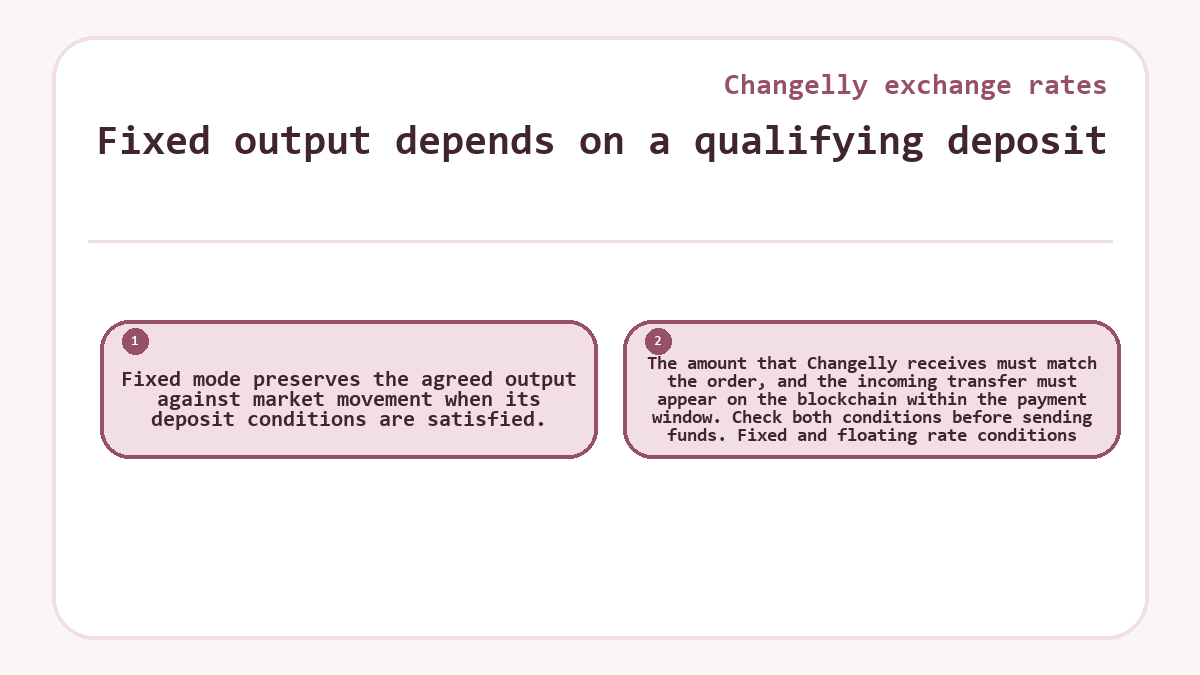
Fixed output depends on a qualifying deposit
Fixed mode preserves the agreed output against market movement when its deposit conditions are satisfied. The amount that Changelly receives must match the order, and the incoming transfer must appear on the blockchain within the payment window. Check both conditions before sending funds. Fixed and floating rate conditions
Compare receivable amounts on the same basis
Separate the rate from the net payout
The net payout is the cryptocurrency remaining for delivery after the applicable deductions. Compare that figure using the same input amount, currency pair and selected networks. Otherwise, a difference in the displayed output may reflect a different transaction rather than a better quote. Keep the sending service’s withdrawal charge separate when assessing the total amount leaving your balance.
Changelly incorporates exchange charges into its pricing, while fixed pricing uses a dynamic fee for protection against market volatility. The transaction details show the relevant deductions. Comparing only a service percentage can miss the cost expressed through the quote itself.
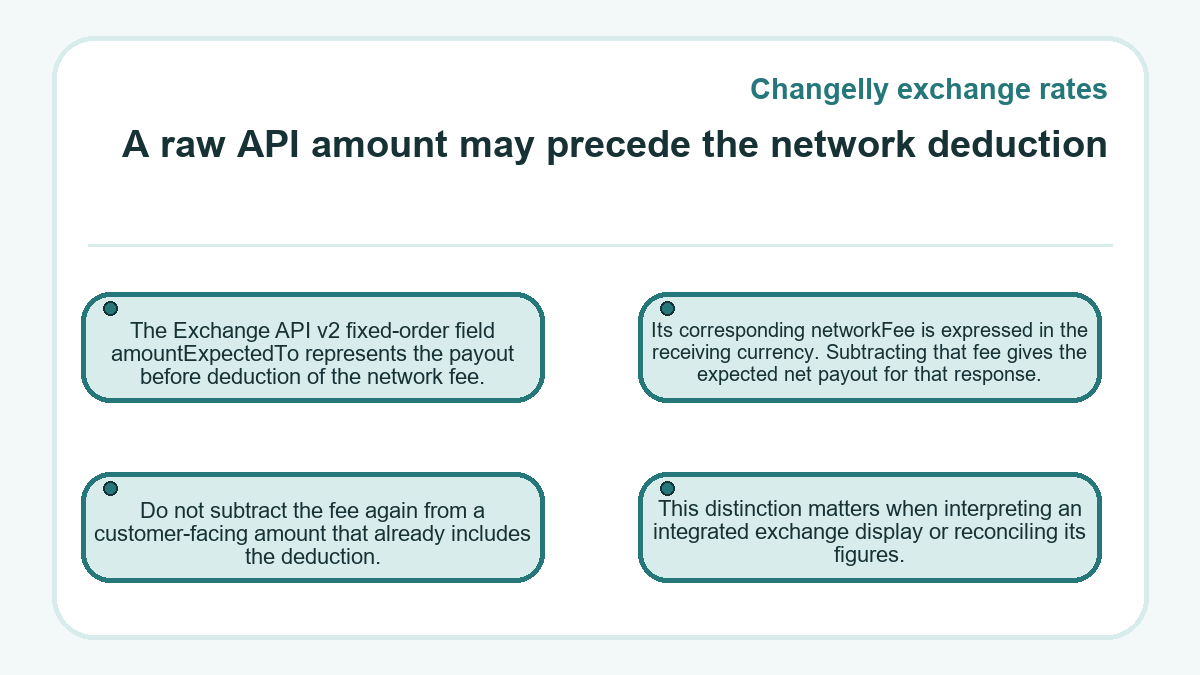
A raw API amount may precede the network deduction
The Exchange API v2 fixed-order field amountExpectedTo represents the payout before deduction of the network fee. Its corresponding networkFee is expressed in the receiving currency. Subtracting that fee gives the expected net payout for that response. This distinction matters when interpreting an integrated exchange display or reconciling its figures. Do not subtract the fee again from a customer-facing amount that already includes the deduction.
Does the payment deadline also set the delivery time?
The payment deadline governs funding eligibility, while delivery depends on the later confirmation, exchange and payout stages. A transfer can satisfy the funding condition while processing continues beyond that deadline. Blockchain confirmations establish the deposit’s progress on its network; the exchange then proceeds when its requirements are met. A fixed rate therefore does not promise delivery before the payment countdown ends.
Quote expiry and order expiry apply at different stages
A fixed quote can expire before an exchange order exists. In the API, the estimation response includes a rate identifier and its expiration timestamp. The application uses that identifier when creating the fixed order. An expired identifier cannot create a new order, even if the previously displayed amount remains visible on screen.
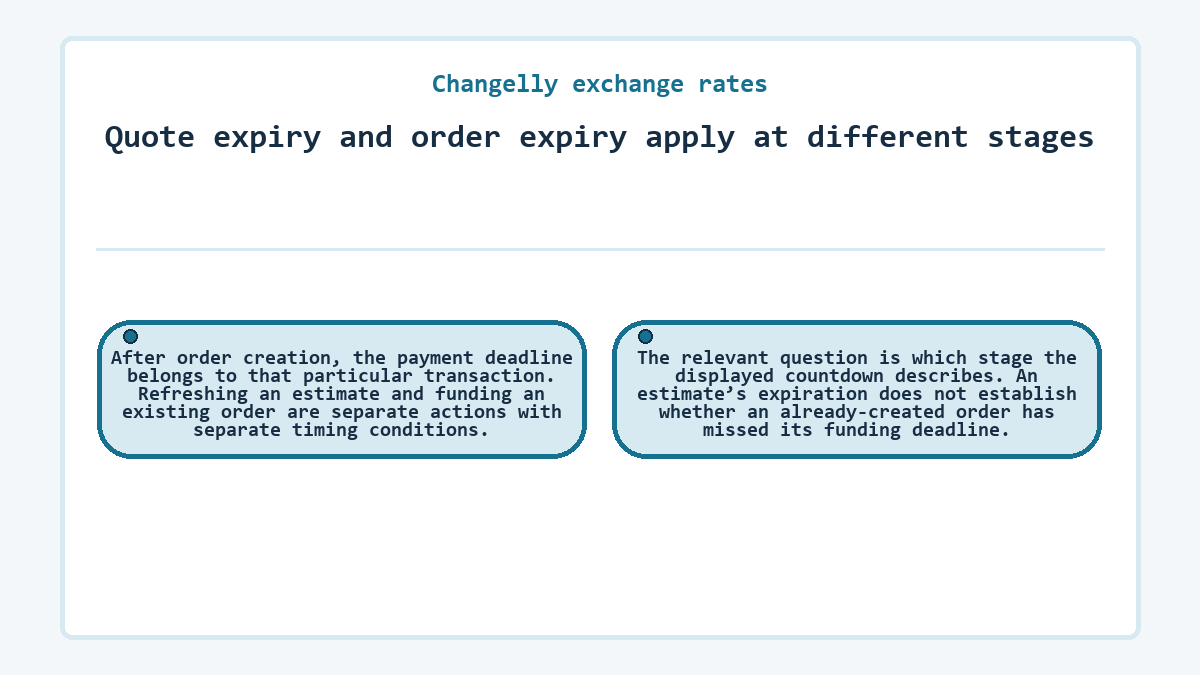
After order creation, the payment deadline belongs to that particular transaction. Refreshing an estimate and funding an existing order are separate actions with separate timing conditions. The relevant question is which stage the displayed countdown describes. An estimate’s expiration does not establish whether an already-created order has missed its funding deadline.
The received deposit determines amount compliance
The fixed amount requirement concerns what reaches the exchange, so a withdrawal charge deducted from the transfer can create a shortfall. Review the sending service’s actual recipient amount before authorizing payment. Floating mode accommodates a changed deposit amount only within the applicable exchange limits; it does not remove the minimum requirement. An incorrect fixed deposit can fail instead of producing the original quoted output.
An expired funded order needs a rate-specific resolution
An expired status requires checking whether the order remained unpaid or whether a deposit appeared on the blockchain after its deadline. The exchange record and deposit transaction provide different parts of that answer. Inspecting them does not commit another payment. An unpaid expired order has no deposit to recover; a funded exception needs investigation.
Late deposits can require manual handling at different market conditions. The earlier fixed quote must not be treated as an automatically available settlement offer. Contact support with the order identifier and deposit details to establish whether processing or a refund is available. Refund feasibility depends partly on whether the deposit covers the relevant network cost.
For a disputed output amount, retain the original quote and its fee breakdown alongside the completed exchange record. A proposed manual conversion needs its own amount comparison. If its net output no longer meets the purpose of the swap, the original quote cannot resolve that mismatch.
Partner displays can produce different quote totals
Changelly’s Exchange API v2 floating estimation method incorporates Changelly and partner extra fees into amountTo before the network fee deduction. A swap initiated through an integrated service can therefore present a different economic offer from another interface. The same underlying exchange provider does not establish identical customer pricing.
Compare offers close together in time and keep their input amounts and rate modes consistent. Inspect whether each displayed receiving amount is already net of the payout network fee. If one figure is an estimate before deductions and another is the amount intended for delivery, their difference does not isolate the exchange rate. Fee treatment must match before the comparison is meaningful.
Which rate mode fits a required receiving amount?
Fixed mode fits an exchange that needs a specified crypto output, provided its net quote meets that requirement and funding conditions are achievable. Floating mode fits a transaction whose purpose remains satisfied even if the output changes during execution. Neither choice becomes suitable merely because its initial number looks attractive.
A required receiving amount is a condition that you set for the transaction, not a protection created by a floating estimate. Evaluate the fixed offer after deductions and consider whether the sending service can meet its payment instructions. If the offer is insufficient or timely funding is uncertain, leaving the exchange unfunded preserves the ability to reconsider before committing cryptocurrency.
What readers ask about Changelly exchange rates
Can a fixed crypto quote preserve the value shown in my local currency?
A fixed crypto quote preserves the agreed cryptocurrency output under its deposit conditions, rather than its later value in local currency. The receiving asset’s market price can change after quotation or delivery. Evaluate a requirement stated in cryptocurrency separately from a spending target stated in government-issued money.
Why can a floating-rate exchange fail during a sharp market move?
Changelly can fail an exchange when market conditions become severely unfavorable during processing. Its troubleshooting terms identify this as a possible failure reason, without supplying a universal percentage threshold. A floating quote should therefore not be interpreted as either a guaranteed output or a promise to execute through every market movement.
What determines whether an amount is eligible for a fixed quote?
The selected pair’s minimum and maximum amounts determine whether a fixed estimation request is eligible. The fixed-rate API requires the requested amount to fall within that range. Minimum amounts account for network costs and the minimum exchangeable market lot, so an amount accepted for one selection may fail another.
Does exchanging back use the reciprocal of the original rate?
A reverse exchange requires a separate quote for its own direction, input amount and applicable deductions. Taking the reciprocal of the original displayed rate does not establish the cryptocurrency that a second exchange would deliver. Market movement and the second transaction’s costs also affect the resulting amount.
Are identity checks removed when I choose a fixed rate?
Choosing a fixed rate does not remove transaction screening or identity checks. An exchange can enter a hold state because of anti-money laundering or Know Your Customer procedures. Rate protection addresses market movement; a hold concerns whether processing may continue after the required review.