 Changelly
 exchanges crypto for delivery to your wallet and connects purchases and sales to payment providers
Last updatedChangelly converts one cryptocurrency into another and sends the exchanged funds to your chosen wallet address. Its marketplace also connects crypto purchases and sales with payment providers. A standard exchange starts with an order and a crypto deposit, then progresses through confirmation, conversion and payout. The receiving asset, network and rate option determine the order conditions. Completion means reconciling the exchange record with the funds received, while failed or held orders need a different resolution.
Swapping crypto, buying with money and selling for a payout
A crypto swap changes the asset you hold, while buying and selling connect cryptocurrency with government-issued fiat currency. The standard exchange accepts the selected input cryptocurrency and arranges delivery of the output cryptocurrency. You supply the receiving address; the exchange service does not provide a personal wallet for storing that output.
Buying begins with a fiat amount and a selected crypto asset. The marketplace presents provider offers, and the chosen provider handles payment and any required verification. Selling moves in the opposite direction: a provider receives crypto and processes a fiat payout through an available payment method. Supported currencies, location and provider requirements determine which offers are available. A sale therefore ends with receipt through the payout method, rather than another crypto balance.
Wallet-connected DeFi swaps provide another exchange path. Their authorization and settlement use smart contracts, which execute programmed rules on a blockchain.
The deposit address and receiving address have different jobs
The deposit address identifies where the input cryptocurrency must go for the standard exchange, while the receiving address determines the output destination. Each side has its own asset and network. A network is the blockchain carrying the transfer; matching an asset name alone does not establish compatibility. The sending wallet and receiving wallet must support their respective selections. Any required memo or destination tag belongs with the address for that particular transfer.
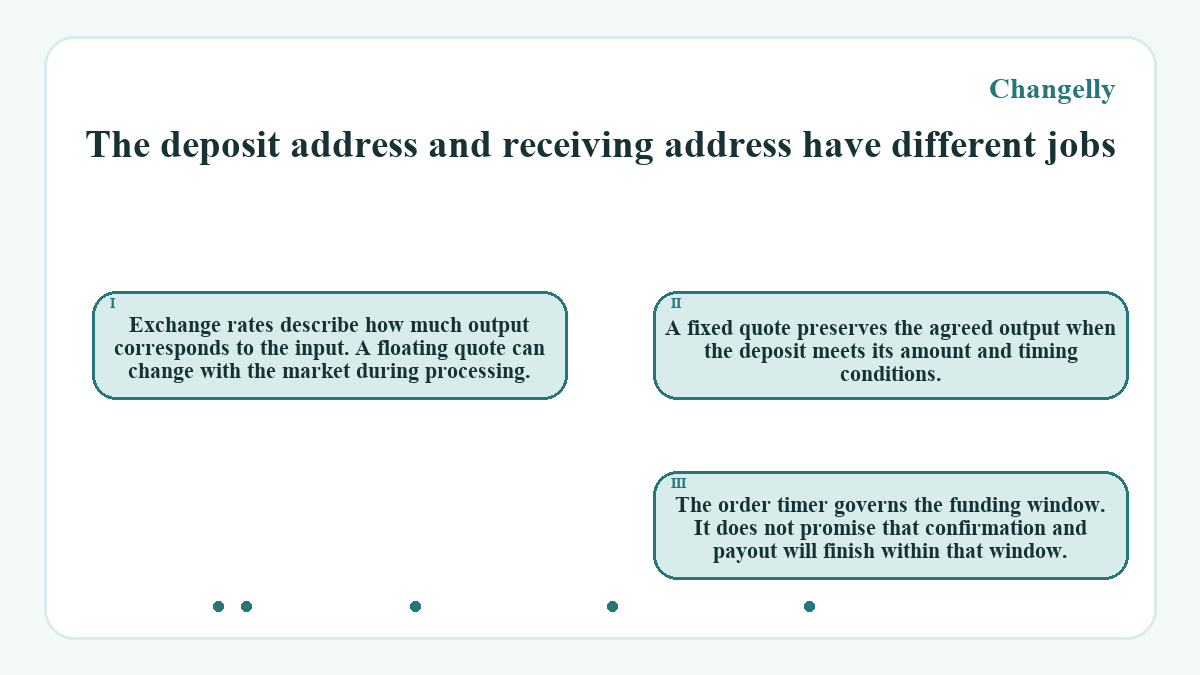
Exchange rates describe how much output corresponds to the input. A floating quote can change with the market during processing. A fixed quote preserves the agreed output when the deposit meets its amount and timing conditions. The order timer governs the funding window. It does not promise that confirmation and payout will finish within that window.
What happens after the deposit reaches Changelly?
The exchange waits for sufficient blockchain confirmations before moving the deposit through conversion and sending the resulting cryptocurrency to the receiving address. Confirmations record a transfer’s inclusion and subsequent progress on its blockchain. Their requirements vary with the asset. An outgoing transfer appearing in a wallet does not by itself establish that the deposit has enough confirmations.
The order status describes the service’s progress. Waiting for payment precedes detection of payment; Confirming concerns blockchain confirmations. Exchanging identifies the conversion stage, and Sending indicates the payout stage. These states help locate a delay without treating every pause as the same problem.
Network congestion and exchange-partner maintenance can delay processing. Repeatedly refreshing the order does not change those underlying conditions.
How can you tell whether the exchange has finished?
A completed exchange should have a finished order record and a matching payout to the destination address on the selected network. The service assigns its own order identifier. A transaction hash identifies a blockchain transfer, so the order identifier and payout hash serve different purposes. The deposit also has a transfer record; checking that record alone describes only the incoming side.
Reconciliation means matching the payout asset, amount and destination against the completed order. A blockchain explorer displays the transfer associated with its hash. A receiving platform may require further confirmations before crediting a balance. If the transfer has arrived on the correct network but the wallet display has not updated, investigate the receiving wallet or platform. Keep the order identifier and relevant transfer hashes for support, without publishing account or transaction details.
Fees change the amount available at the destination
The amount displayed for receipt reflects the quote’s exchange costs and network fee, while the sending wallet may charge separately for the deposit transfer. A fee deducted from the amount sent can leave the order underfunded. Fixed and floating exchanges use different pricing arrangements, so a quoted percentage alone does not describe both. Payment providers set their own charges for purchases and sales. Compare offers using the same input amount and payment method, then inspect the amount that the destination should receive. This keeps a service charge, a transfer cost and a change in the exchange rate from being mistaken for one another.
Identity checks can interrupt an otherwise valid deposit
A Hold status indicates that transaction screening has flagged the transfer for identity verification. KYC means Know Your Customer, the identity-checking process. AML means Anti-Money Laundering, which includes monitoring transactions and assessing their origins.
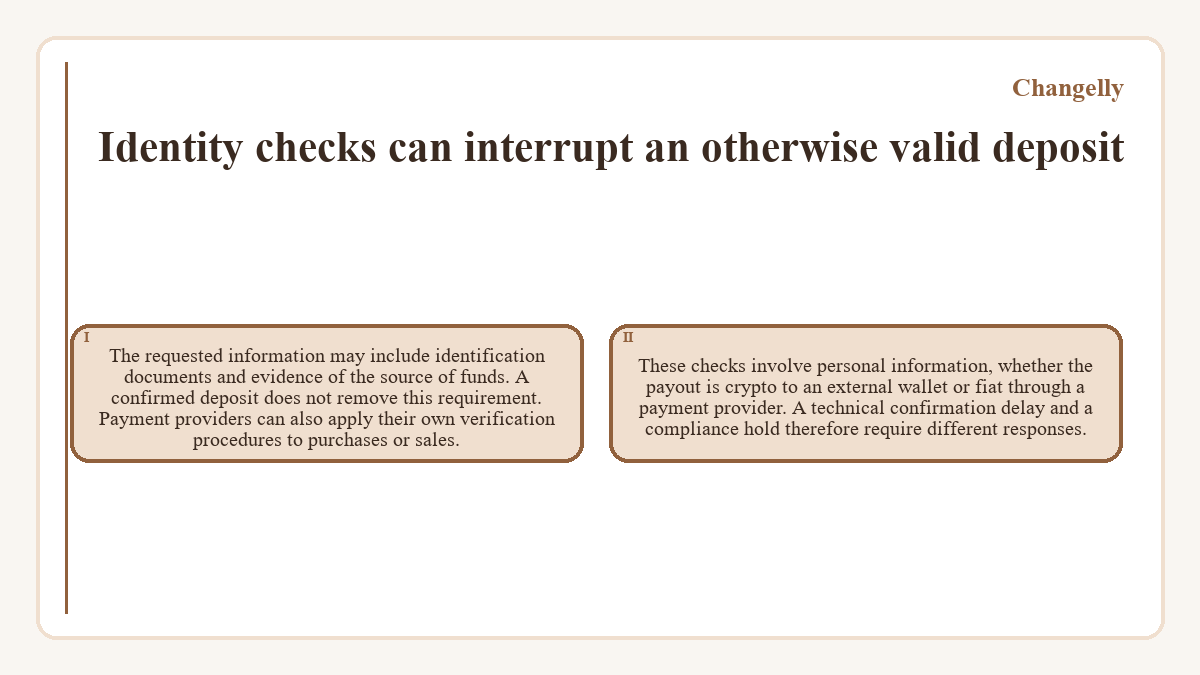
The requested information may include identification documents and evidence of the source of funds. A confirmed deposit does not remove this requirement. Payment providers can also apply their own verification procedures to purchases or sales. These checks involve personal information, whether the payout is crypto to an external wallet or fiat through a payment provider. A technical confirmation delay and a compliance hold therefore require different responses.
Refund availability depends on the transaction and its circumstances. Recovery can incur fees, and some incorrect or insufficient deposits cannot be returned.
Wallet authorization changes the mechanics of DeFi swaps
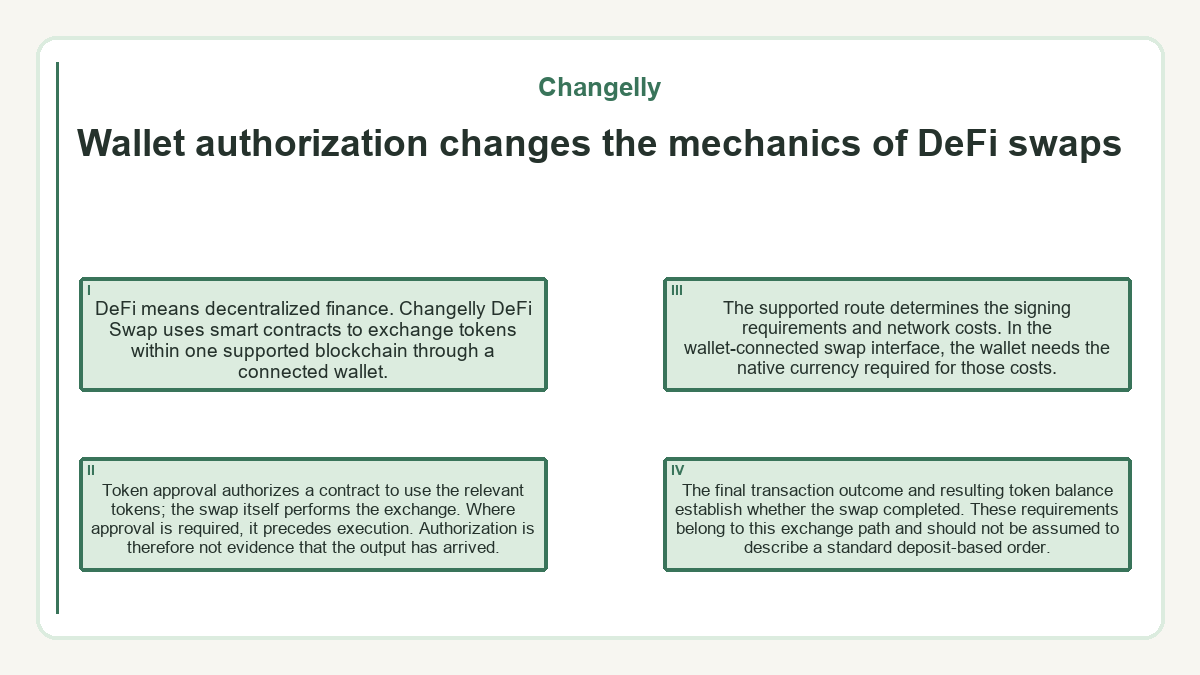
DeFi means decentralized finance. Changelly DeFi Swap uses smart contracts to exchange tokens within one supported blockchain through a connected wallet. Token approval authorizes a contract to use the relevant tokens; the swap itself performs the exchange. Where approval is required, it precedes execution. Authorization is therefore not evidence that the output has arrived. The supported route determines the signing requirements and network costs. In the wallet-connected swap interface, the wallet needs the native currency required for those costs. The final transaction outcome and resulting token balance establish whether the swap completed. These requirements belong to this exchange path and should not be assumed to describe a standard deposit-based order.
Can you leave an exchange unpaid instead of committing funds?
You can abandon an unfunded standard exchange by withholding the deposit and allowing the order to expire. Leaving it unpaid keeps the input in your wallet but does not preserve an expiring quote. Funding it allows conversion to proceed and introduces confirmation, processing and possible review delays.
- Leave the order unpaid if the output network or receiving address does not match the intended destination.
- Before funding, confirm that the deposit can meet the displayed amount and timing conditions.
- If you must verify receipt before another transfer, wait for the payout record and destination credit.
- For a held or failed order, establish its resolution before sending another payment.
- Match any refund to the returned input asset and applicable deductions, rather than the originally quoted output.
A completed crypto payout cannot be canceled by Changelly. Support may be able to intervene before payout, but stopping an exchange or recovering a deposit is not assured. Once the destination receipt matches the completed order, that received balance provides the basis for the next transfer.
Helpful answers about Changelly
Can a previous Changelly deposit address be used again?
Each standard exchange requires a new order and its newly generated deposit address. Deposit addresses are not reusable and have a funding window. Sending to an old address can require manual intervention instead of automatic processing. An earlier successful transfer does not make that address suitable for another exchange.
What determines the minimum exchange amount?
The minimum must cover the network cost and satisfy the smallest amount that the exchange market can process. It can vary with the pair and market conditions. Purchase and sale limits also depend on the payment provider. Use the minimum displayed for the selected order, rather than a figure from an earlier transaction.
Why can verification be requested again after an earlier check?
Previous verification does not prevent a later request for additional information. Transaction screening can identify circumstances that require another review, including questions about the source of funds. The request concerns the transaction under review; a verified account does not establish that every future transfer will complete without further checks.
Are Changelly services available in every country?
Access is subject to location restrictions and eligibility conditions. Marketplace providers may impose additional limits on supported countries, currencies or payment methods. An accessible website or visible quote does not establish eligibility. The service and the provider handling the transaction must both support its use in the relevant circumstances.
Does Changelly offer mobile crypto exchanges?
The mobile app supports crypto exchanges and purchases on iOS and Android. Exchange orders still require a compatible receiving wallet, and their amount, rate and funding conditions apply. Using the app does not turn the exchange service into a wallet for storing the resulting cryptocurrency.
Which transfer details identify a deposit that needs a memo?
A required memo or destination tag supplies an extra identifier alongside the deposit address. It helps associate the payment with its intended recipient or account. Use the value specified for that transfer. An omitted or incorrect identifier can prevent automatic processing even when the blockchain transfer itself succeeds.